

Issue 07 · September 2026 · 3 backtests · 7 delays · 3,096 trades re-priced
There is one number in every backtest that almost nobody questions: the fill price. The backtest trades at the next bar's open, the instant its signal appears. Nobody trades that fast. Not a person at a screen, and not a retail trading bot.
So we asked a simple question about three strategies from earlier issues. What happens to them at the speed a real system can actually trade?
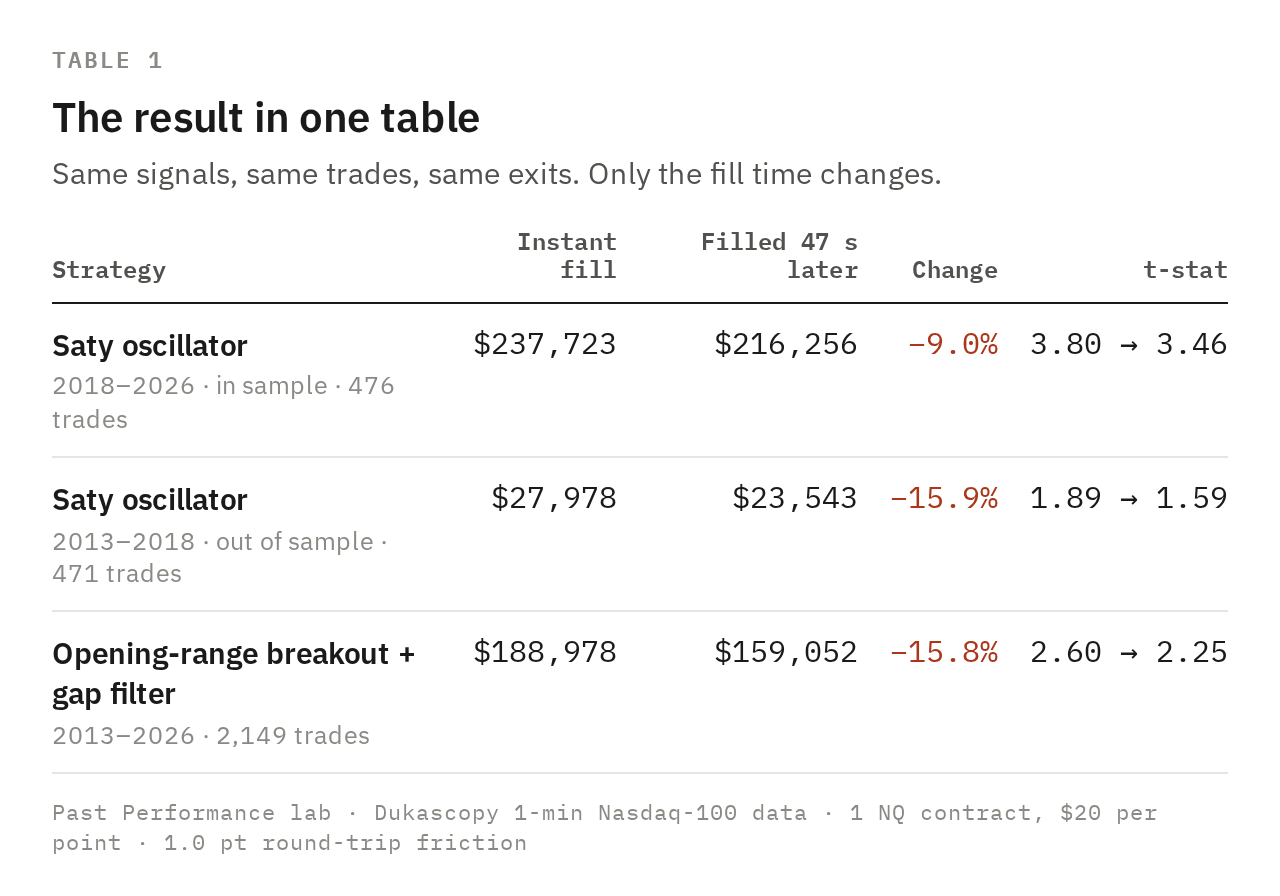
A 47-second delay costs 9–16% of profit · At two minutes the breakout's edge stops looking real
Same signals, same trades, same exits. Only the fill time changes.
01 / THE ASSUMPTION
The fill that never happens
A backtest sees the bar close and fills on the spot. A live system has to wait for its broker to publish that bar, decide, and send the order. On our own automated service the whole trip takes about 47 seconds.
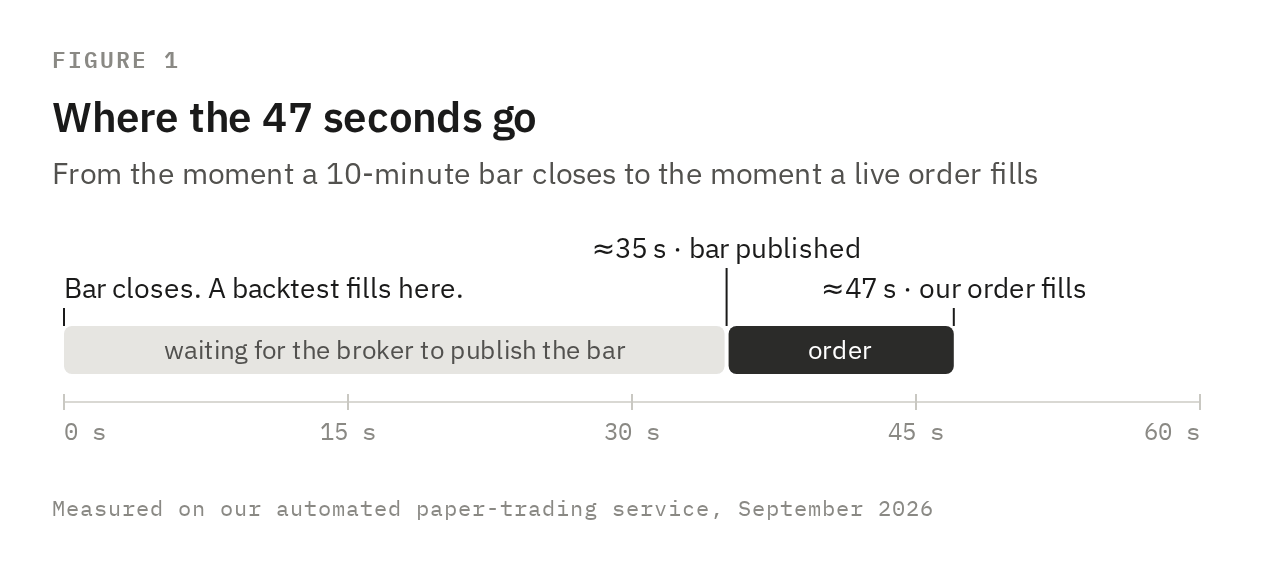
Forty-seven seconds sounds harmless. For a strategy that trades momentum, it can be a good part of the move.
02 / THE TEST
Same trades, later fills
We changed exactly one thing: the moment each market order fills. The signals, the trades and the exits all stayed where they were. Then we stepped the delay from zero to five minutes and re-priced every order on one-minute data.
The strategies: the Saty Phase Oscillator on Nasdaq-100 futures, split into the years it was built on and the years before (Issue 06), and the opening-range breakout with a gap filter, the one strategy from Issue 01 we managed to rescue.
03 / THE RESULTS
Profit leaks, and it leaks early
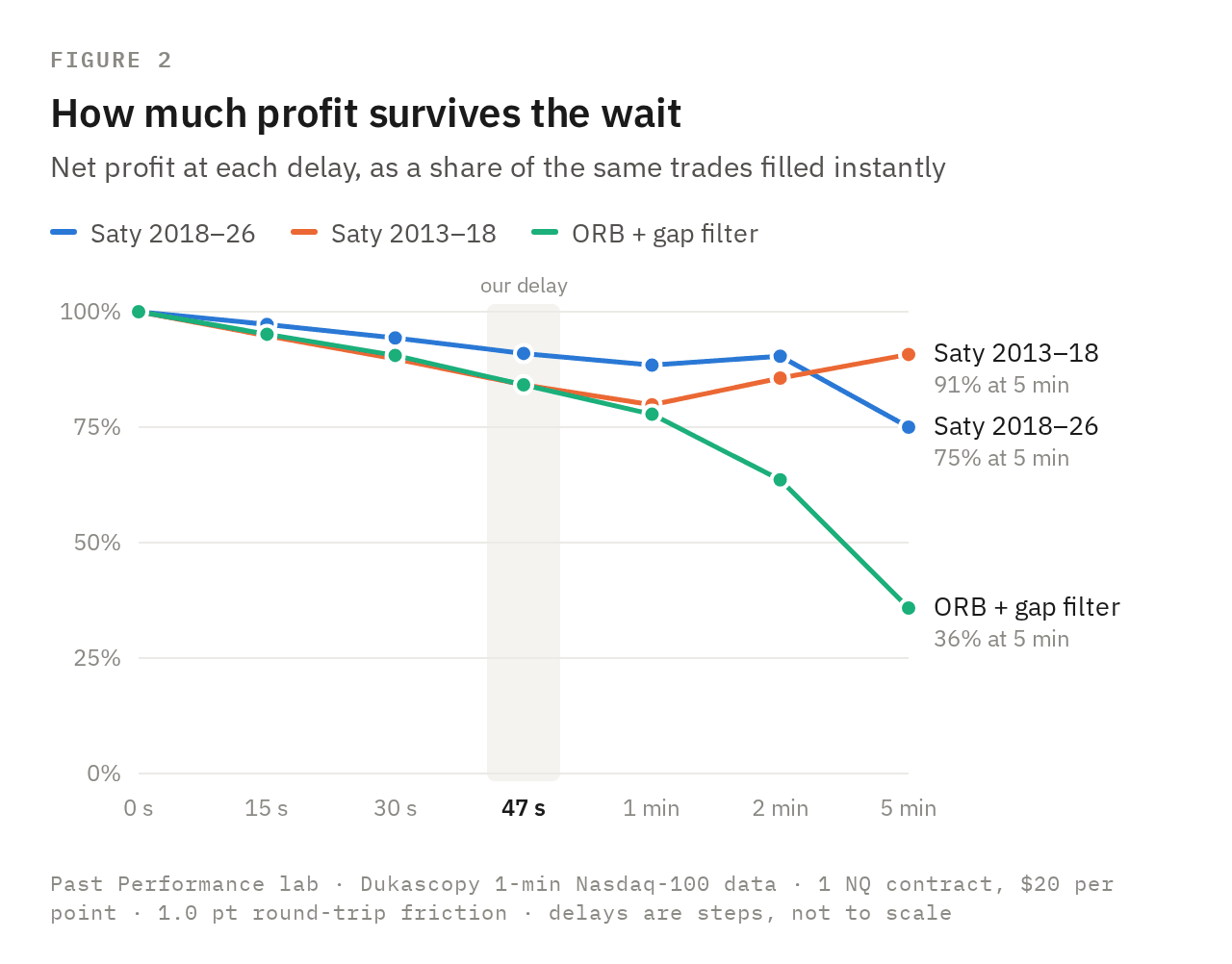
The out-of-sample Saty line runs almost exactly under the breakout until 47 seconds. Past one minute the Saty figures bounce around: at that horizon the noise is bigger than the effect.
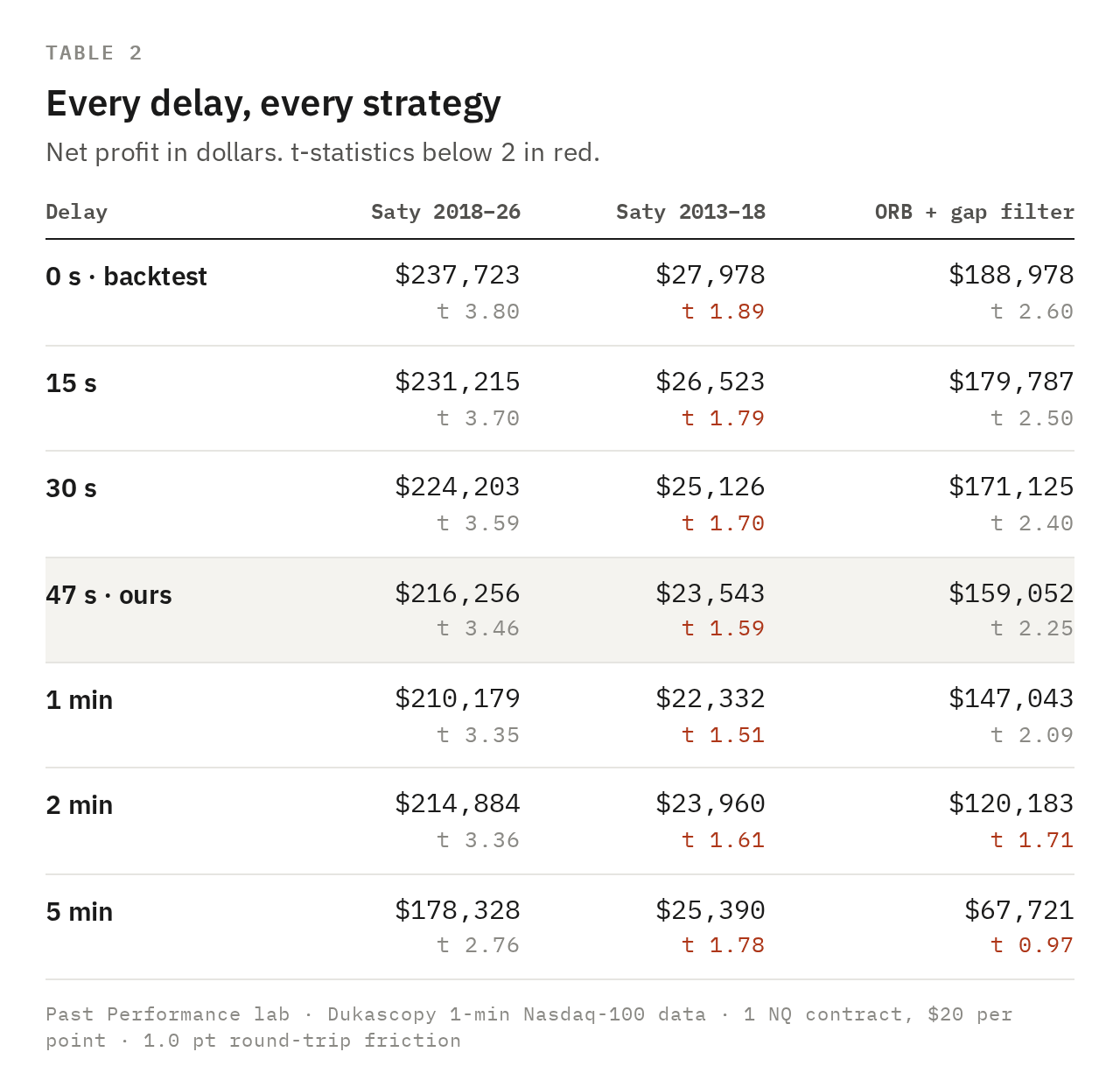
The first fifteen seconds already cost something. By our real delay, every version has given back between a tenth and a sixth of its profit. The breakout keeps sliding from there, and five minutes late most of its profit is gone.
This is not noise. Across all 3,096 trades the cost of waiting is consistent: these strategies trade moves that keep going for about a minute, and a slow system simply buys them later.
04 / THE EDGE
When a real edge stops being real
Losing some profit is survivable. Losing the evidence is not. The t-statistic tells you whether a result stands out from luck, and 2 is the usual bar.
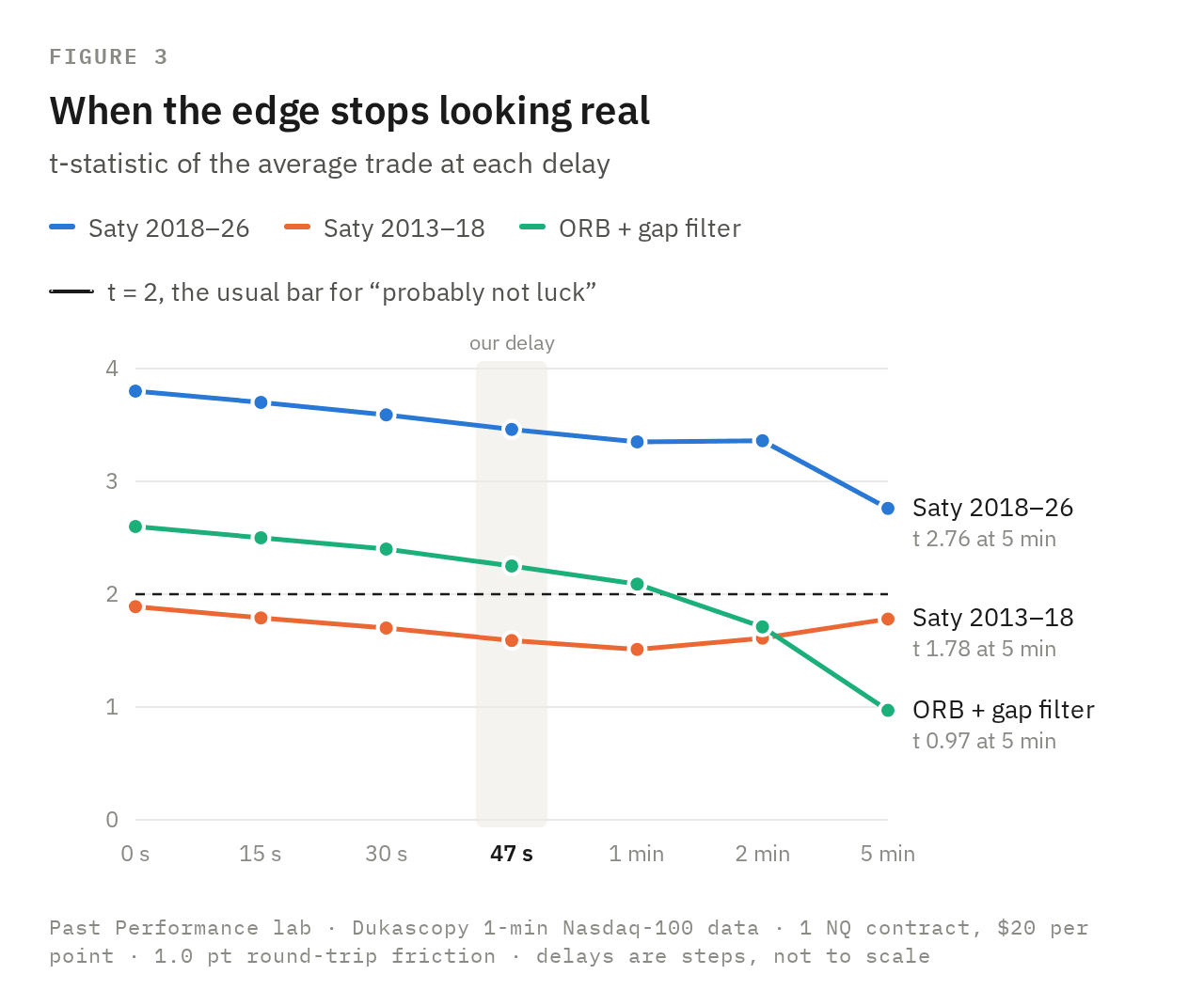
The breakout clears that bar with a one-minute delay and fails it at two minutes. The in-sample Saty result survives every delay we tried. The out-of-sample one never cleared the bar, even at zero seconds, which is what Issue 06 was about.
05 / ON ONE TRADE
What the wait looks like in points
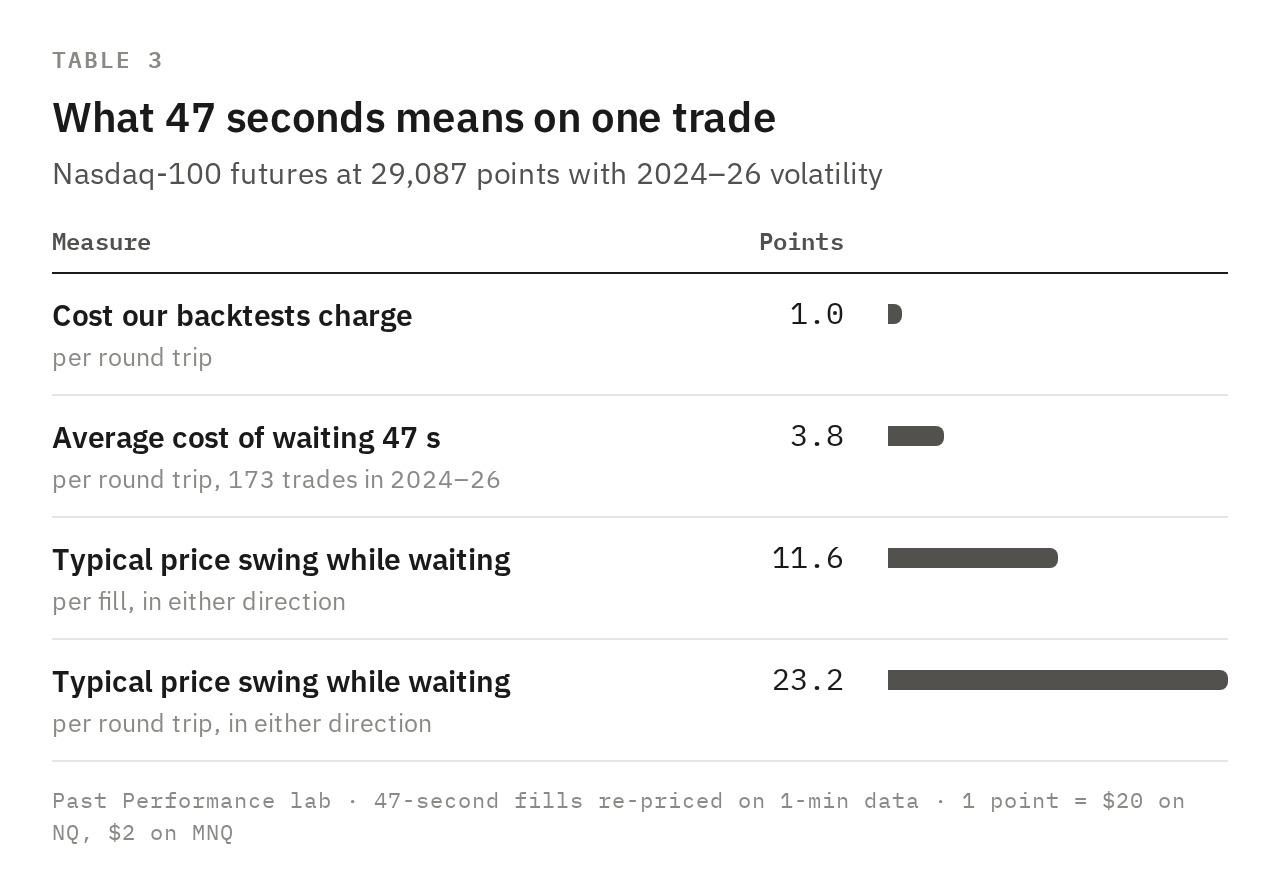
Our backtests charge one point per round trip for commissions and slippage. The wait alone swings a round trip by more than twenty times that, in either direction. On average the swing lands against you, at almost four times the cost we charge.
06 / THE TRANSFERABLE PART
Three checks before you trust a backtest
Time your own delay. Measure it on your own setup, from the bar close to the fill. It is never zero.
Re-price the backtest at that delay. If your platform cannot, fill at the close of the next one-minute bar instead of its open. It is a crude but honest stand-in for a one-minute delay.
Prefer edges that survive a minute. A strategy that only works at zero seconds is a feature of the backtest, not of the market. Or get faster: at 15 seconds, the Saty strategy's delay cost falls to less than a third of what it is at 47.
YOUR TURN
Send us the strategy you are about to risk money on
Leave a comment with a link to the rules, the video or the paper. We read every one. The strongest go into the testing queue, and each is tested the same way: with costs, at the account level, out of sample and at a realistic delay.
Method
Data: Dukascopy one-minute bid prices for the Nasdaq-100, a CFD proxy for NQ futures. One NQ contract at $20 per point, with 1.0 point of round-trip friction on top of every delay.
Re-pricing: below 60 seconds, each fill is interpolated inside its one-minute bar. At 60 seconds it is that bar's close. At two and five minutes it is the close of the one-minute bar ending at that time. The breakout's stops and targets are resting orders and stay unchanged.
Controls: at zero delay every re-priced entry matches the original backtest, and profits reproduce to the dollar. Interpolation understates the swing inside a minute, so these costs are conservative. The delay cost is statistically solid, with t-statistics between 2.8 and 4.1.
Backtested results are hypothetical and do not represent returns any investor achieved. This is research, not investment advice.