

Issue 12 · November 2026 · 32 sessions, 1,209 ten-minute bars
Most traders test a strategy on a paper account before risking money. If its prices arrive late, the test measures the wrong thing, and nothing on screen tells you.
For four weeks in September our paper account traded a futures strategy on prices that were ten minutes old. The engine logged errors when bars failed to arrive, but not one message said the data was delayed.
We found it by comparing every decision with the finished bar after the close. The gap was too steady to be noise, and almost any retail setup can fall into it.
Verdict: a paper test on delayed data tests the data, not the strategy.
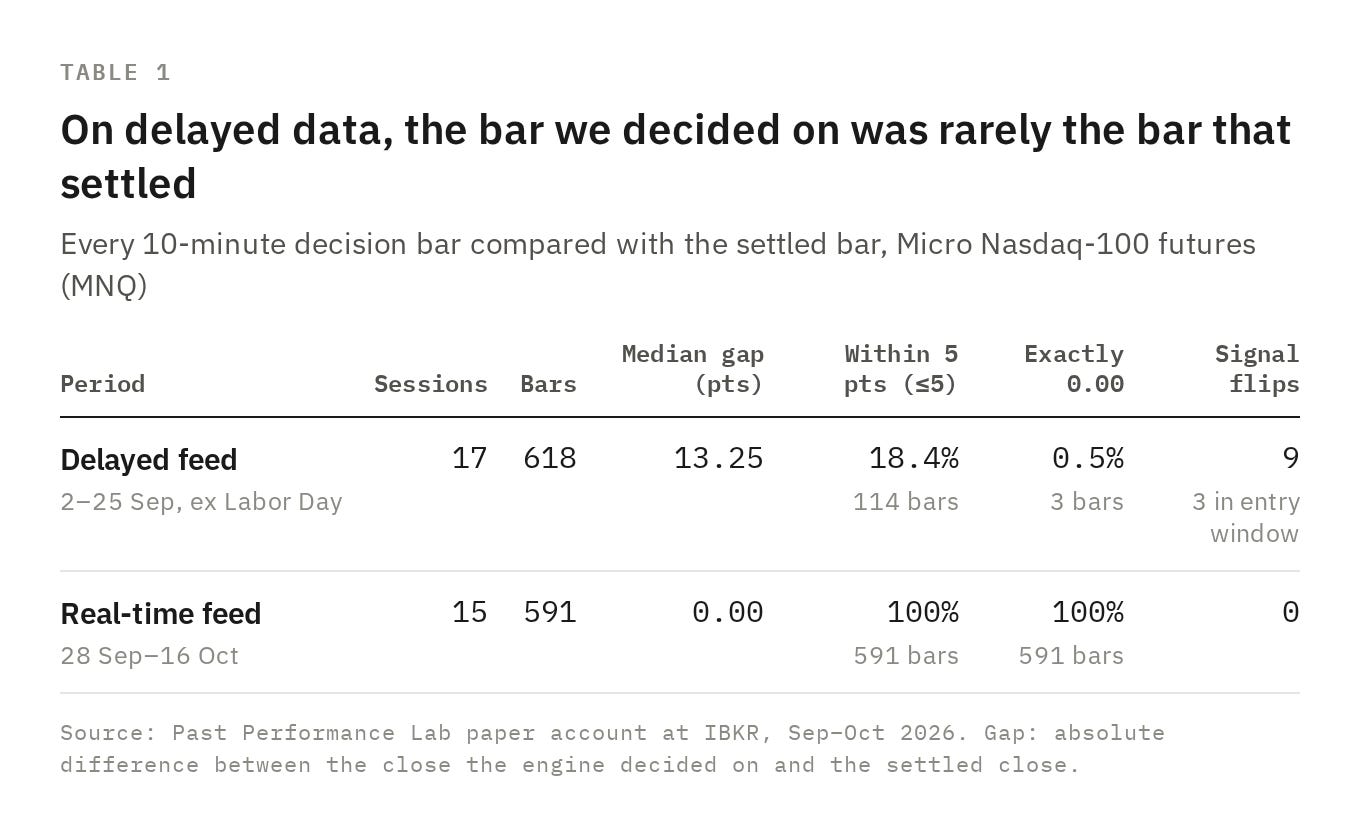
Method: 17 NYSE sessions on 10-minute-delayed CME data (2–25 Sep 2026) vs 15 sessions on real-time data (28 Sep–16 Oct), Micro Nasdaq futures, every 10-minute decision bar compared with the settled bar.
Three checks before you trust a paper result
Ask your platform which feed you are on. In the IBKR API,
reqMarketDataTypesets the feed you ask for, and the market-data-type message tells you which one you got: 1 is live, 3 is delayed. That message answers areqMktDatarequest, so make one at startup and log the result.Check the newest bar's last trade time against the clock. On a delayed feed the bar's label still looks right. Compare the time of its last trade, or the latest tick, with the clock at the boundary; if it lags by more than a few seconds, you are behind.
Compare each decision with the settled bar after the close. Count how often the signal would have changed. Zero is the target; ours was 9 in 618, 3 of them inside the entry window.
01 / WHAT HAPPENED
The account was never sent real-time prices, and nothing said so
Our paper lane runs the Saty Phase Oscillator strategy from Issue 06 on 10-minute bars of Micro Nasdaq futures at Interactive Brokers. An IBKR paper account has no real-time exchange data of its own; it borrows the live account's subscriptions, if they are shared. Ours had none for CME futures, so IBKR served the free feed, ten minutes behind.
The bar requests our engine relied on never mentioned the delay. Two requests it never made would have: a live-quote request (IBKR Error 354) and a real-time-bars request (Error 420).
02 / WHAT IT DID
Each decision used the previous bar plus a few seconds
At each 10-minute boundary the engine took the newest finished bar. On a feed ten minutes late, that “newest” bar was really the one before, holding only its first seconds of trading, yet it looked complete and carried the right time.
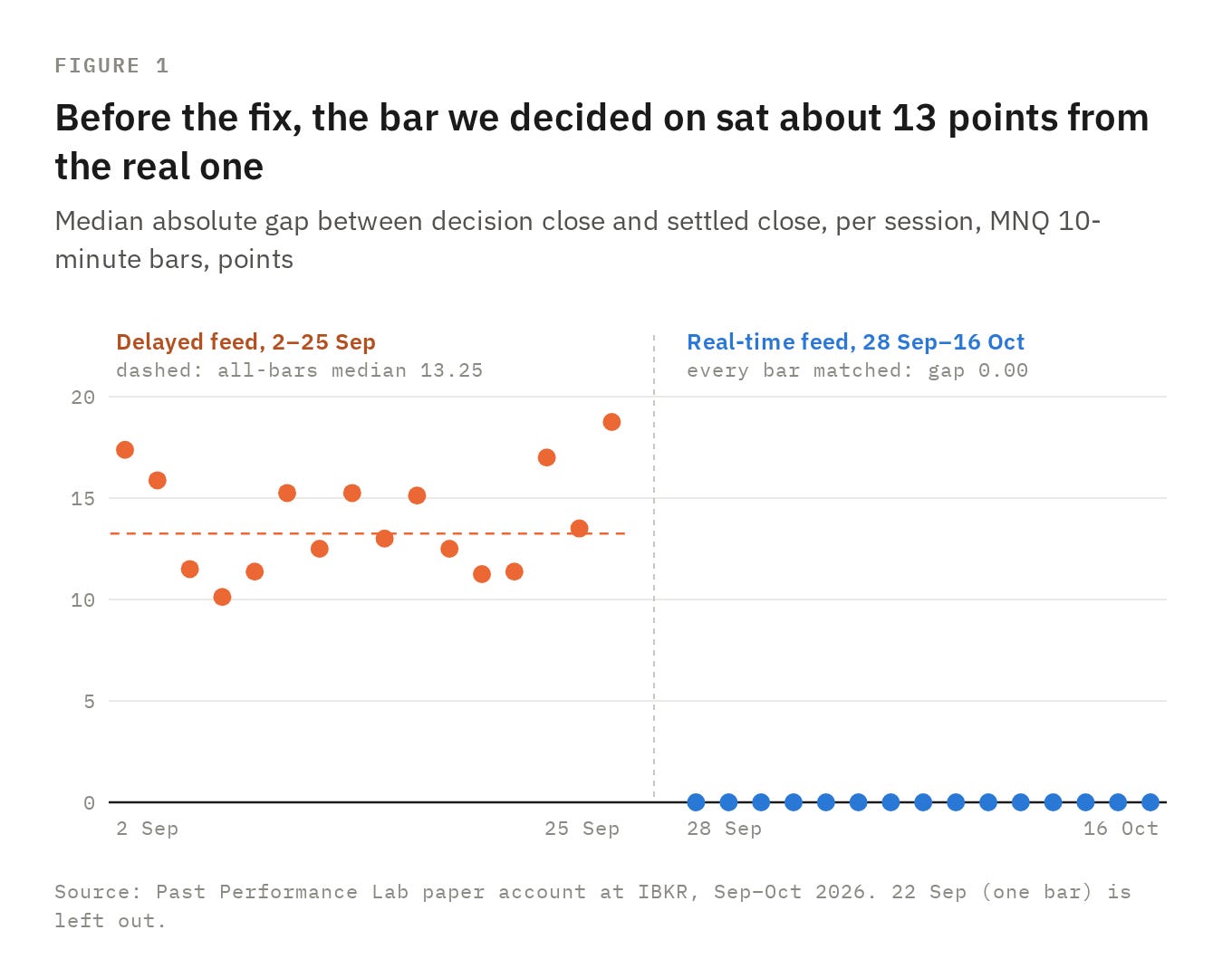
Across 618 decision bars, the price the engine acted on sat a median of about 13 points from the bar that actually settled. Fewer than one bar in five came within 5 points (114 of 618). On 9 bars the settled bar would have changed the signal itself, 3 of them inside the entry window.
03 / THE FIX
A small data subscription and bars we build ourselves
The fix cost USD 1.55 a month: the CME real-time data package on the live account, shared with the paper account. We also changed the engine to build each 10-minute bar from the 1-minute stream, so a bar counts only when all ten of its minutes are in.
Since then, across 591 bars to 16 October, the bar the engine decided on was the bar that settled, every time; no signal flipped. Part of that match comes from building both from the same 1-minute stream, so read it as “the engine now waits for the finished bar”, not as a measure of the feed.
04 / WHY IT MATTERS
Fills were real; decisions were not
The paper fills always came at real-time prices, so the P&L looked like trading while the signals came from the past. That is the danger: plausible results get no second look. A backtest always sees the finished bar; live, you get it only with real-time data and code that waits for the close.
Your turn
Send us the strategy you are about to risk money on, or the paper result you are about to trust. Reply to this email or write to [email protected]. The first reader submission becomes Reader Test #1.
Method
Instrument and strategy: MNQ (Micro E-mini Nasdaq-100 futures), September 2026 contract until the 11 Sep roll, then December; Saty Phase Oscillator rules as in Issue 06; 10-minute bars, regular trading hours.
Delayed period: 2–25 Sep 2026, 17 sessions, 618 bars; 7 Sep (Labor Day, NYSE closed) excluded. 22 Sep has one bar: counted in the totals, left out of the per-session medians.
Real-time period: 28 Sep–16 Oct 2026, 15 sessions, 591 bars, engine building bars from 1-minute data.
Measure: the absolute gap between the close the engine decided on and the settled close, re-read after the session (16:20 ET from 16 Sep; the 2–15 Sep sessions on 16 Sep). “Within 5 points” includes 5.00. A “flip” is a bar where the settled bar would have changed the signal.
Not affected: every backtest and published verdict (Dukascopy and settled data), and the paper fills (real-time prices).
Source: our IBKR paper account's event log (derived statistics only).
Full method: How We Test a Trading Strategy.
Past performance is no guarantee of future results. We check anyway.
This is research on historical data, not investment advice. Full disclaimer.