

Issue 13 · November 2026 · 4 dip-buying rules · 1 pass rule, written first · QQQ 2013–2026
Since 2013, each of these four rules trailed QQQ when it replaced QQQ. Added on top of QQQ, all four earned more. The top-up holds QQQ in full and borrows to double it on signal days.
The risk is plain leverage, which wins whenever the market outruns borrowing costs. So we first wrote down a win: more return than QQQ, more than steady leverage, and no deeper worst fall than steady leverage.
We wrote the pass rule on 28 October, before the test ran, and report it unchanged.
Verdict: mixed, 2 of 4 rules pass. Should you use one? Not instead of QQQ. As an add-on, the test shows more return and deeper falls: every one fell further than QQQ.
QQQ with dividends, 9 Jan 2013 – 30 Sep 2026, buy at the next open, borrowing at the US short-term government (T-bill) rate plus 1.5 points, 0.02% per buy or sell.
Three checks before you trust a “beats buy-and-hold” claim
Compare it with steady leverage. For example, a rule that borrows on a quarter of days must beat borrowing a quarter extra every day.
Test the price you can actually get. Buying at the close means an order sent minutes before the bell. If you trade the next morning, test the next open.
Write the pass rule first. Then report the result, even when a rule misses by half a point.
01 / THE TEST
Four dip-buying rules, one fair opponent
Williams %R comes from Quantified Strategies; we used its first exit (a close above the prior day’s high) and a 2-day lookback, the shortest it tested. KAMA (an adaptive moving average) mean reversion comes from a Quantified Strategies video; Kaufman’s default 2 and 30 settings are our assumption.
Triple RSI comes from Quantified Strategies too (our Issue 10). Connors RSI(2) is from Larry Connors and Cesar Alvarez’s Short Term Trading Strategies That Work (our Issue 05).
The opponent, steady leverage, borrows the same average amount every day.
We charged the T-bill rate plus 1.5 points, close to the cheapest retail margin rates; most brokers charge more. Every trade fills at the next open, a price you can get with a day job.
02 / WHAT REPLICATED
All four beat QQQ and steady leverage on return
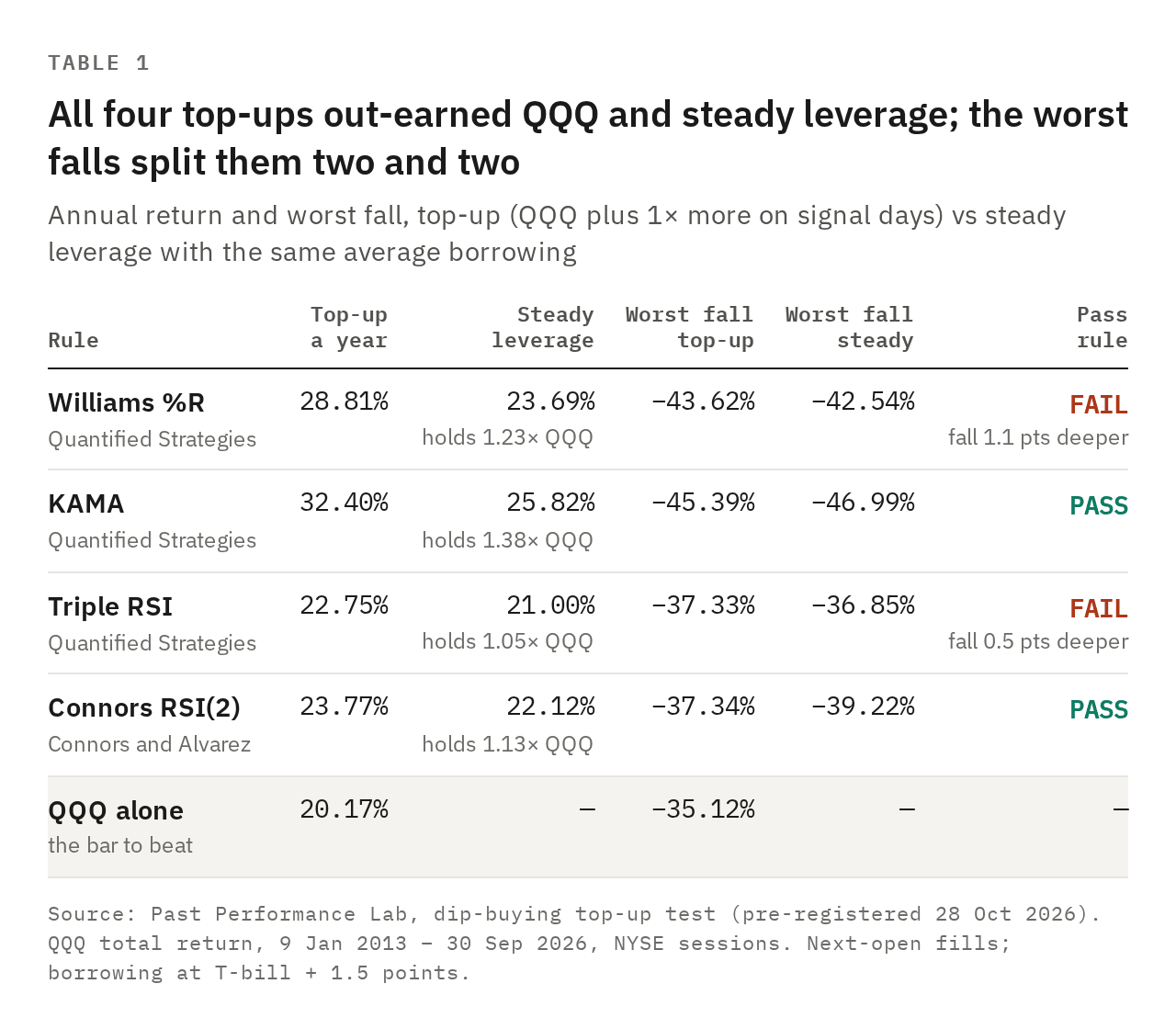
Every top-up beat QQQ alone, and beat steady leverage by 1.7 to 6.6 points a year.
In this historical test, from January 2013 to September 2026, QQQ alone turned $10,000 into about $124,000.
The top-ups ranged from about $166,000 (Triple RSI) to $471,000 (KAMA). Steady leverage with KAMA’s borrowing made about $234,000.
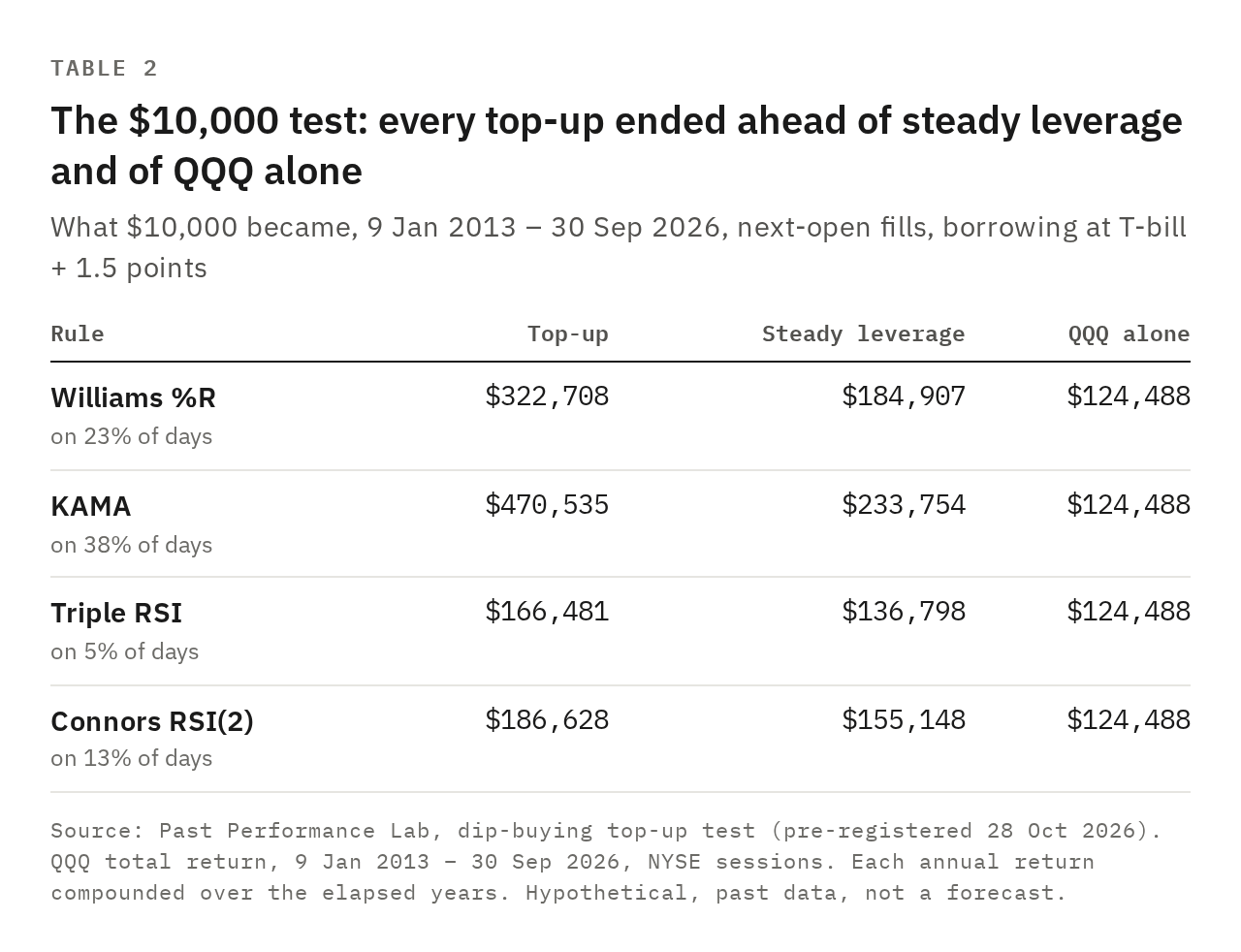
If you already hold QQQ, that is the news: on these dates, the dip signal earned more than borrowing alone.
03 / WHAT SPLIT THEM
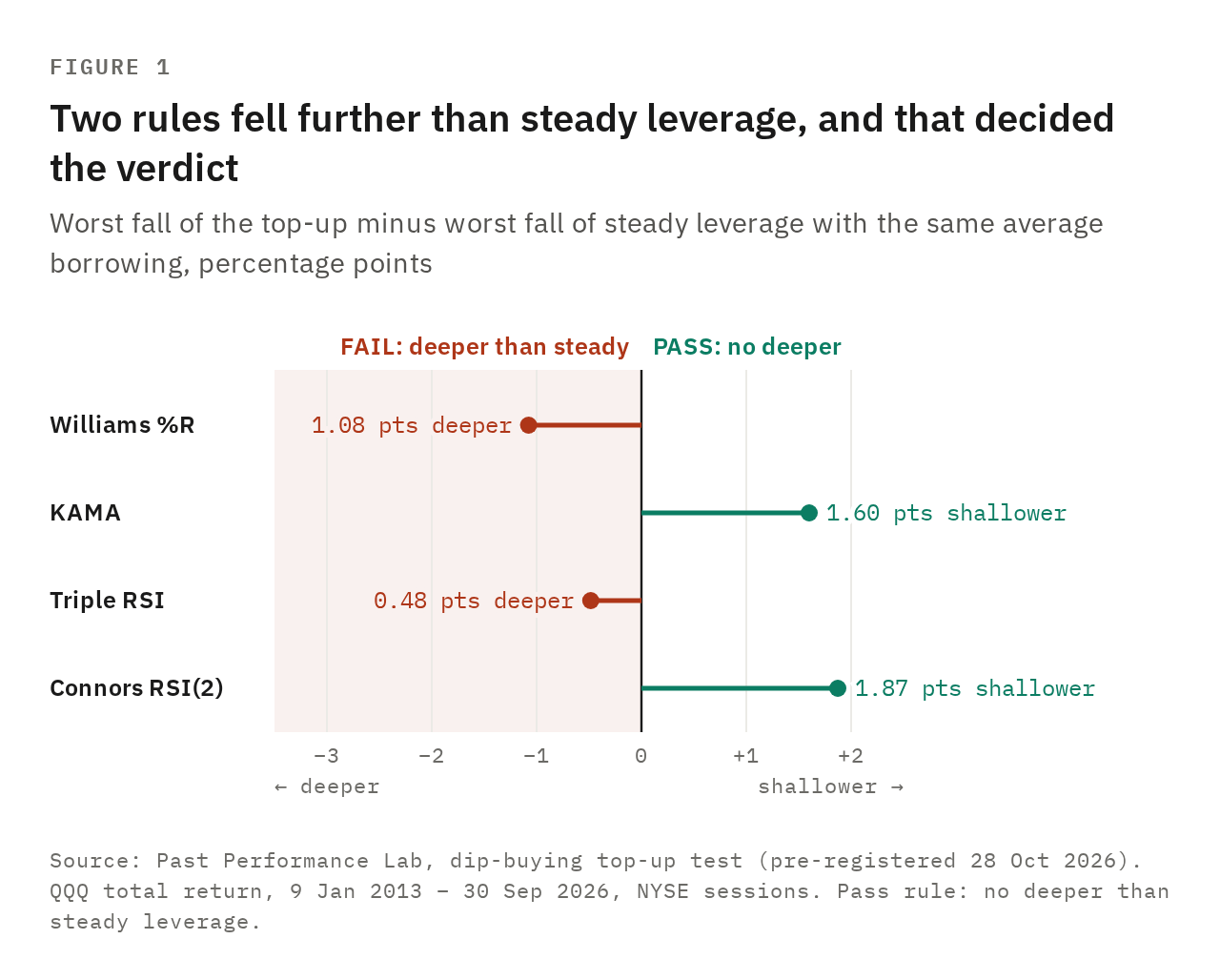
The worst falls decided it, by about a point or less
The worst fall is the biggest drop from a peak to a later low. The last test: a top-up’s worst fall could be no deeper than steady leverage’s. KAMA and Connors RSI(2) cleared it. Williams %R missed by 1.1 points, Triple RSI by 0.5.
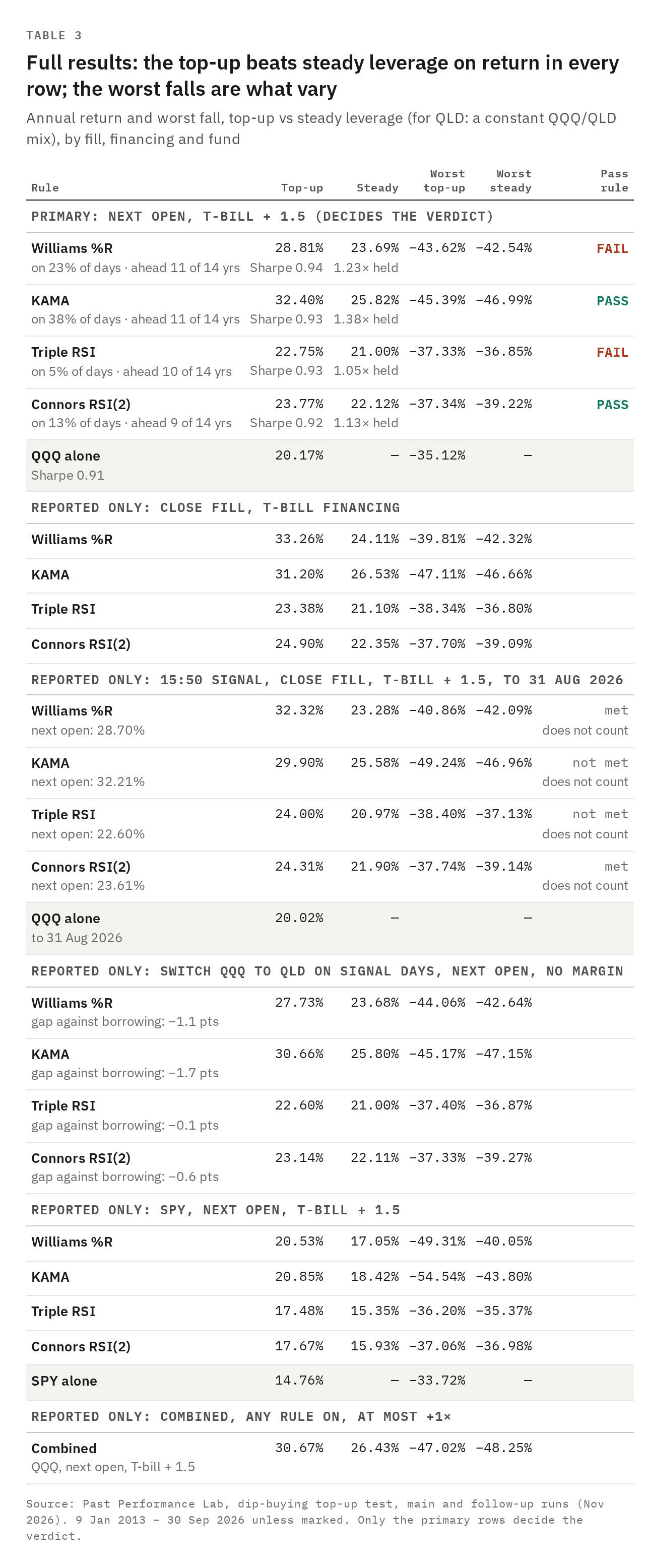
Williams %R’s edge needs a buy at the close, not the next morning (box below).
Every top-up fell further than QQQ’s own worst drop of 35%. If a fall like that would make you sell, skip these rules.
How you trade it matters (reported only)
These checks decide nothing.
Williams %R needs a buy at the closing price. Signalled at 15:50 New York time and bought at the close, it earned 32% a year to 31 Aug 2026; at the next open, 29%.
KAMA is the reverse. It earned 32% at the next open and 30% with the 15:50 signal.
No margin account? Without a margin account, the same signals can swap QQQ for QLD, a fund that moves twice QQQ’s daily change. It cost a fraction of a point to under two points a year against borrowing.
04 / SHOULD YOU USE IT
At most an add-on, and only if deeper falls would not shake you
Run alone, none of these four rules beat QQQ since 2013. As top-ups, two passed and two narrowly failed. All of them borrow, and borrowing deepens the bad years. The question is whether you could hold through one.
Your turn
Send us the strategy you are about to risk money on. Reply to this email or write to [email protected].
Method
Pass rule, written 28 Oct 2026. Beat QQQ and steady leverage on annual return, with a worst fall no deeper than steady leverage’s. The family holds at 3–4 passes, is mixed at 2 and fails at 0–1.
Steady leverage holds 1 + E times QQQ daily, where E is the share of sessions with the top-up on. It borrows at the same rate. It pays no trading costs, which favours it.
Rules, frozen as first tested. Williams %R(2) below −90, exit on a close above the prior day’s high; KAMA(5, 2, 30) mean reversion; Triple RSI as in Issue 10; Connors RSI(2) as in Issue 05.
Data. Total-return prices frozen 7 Oct 2026, NYSE sessions, daily T-bill cash, annual returns by elapsed years.
The rules’ authors are welcome to reply; we will publish any answer in full.
Full method: How We Test a Trading Strategy.
Past performance is no guarantee of future results. We check anyway.
This is research on historical data, not investment advice. Full disclaimer.